
We are often asked what are the main elements of a successful business that would be easier to exit or have higher value. The two are linked, of course, but a key element is related to the founder problem. You may be the best entrepreneur, work the longest hours, know all the properties and owners intimately, but this is often not good for transition or growth process, especially when considering Founder Dependency.

We are often asked what are the main elements of a successful business that would be easier to exit or have higher value. The two are linked, of course, but a key element is related to the founder problem. You may be the best entrepreneur, work the longest hours, know all the properties and owners intimately, but this is often not good for transition or growth process, especially when considering Founder Dependency.
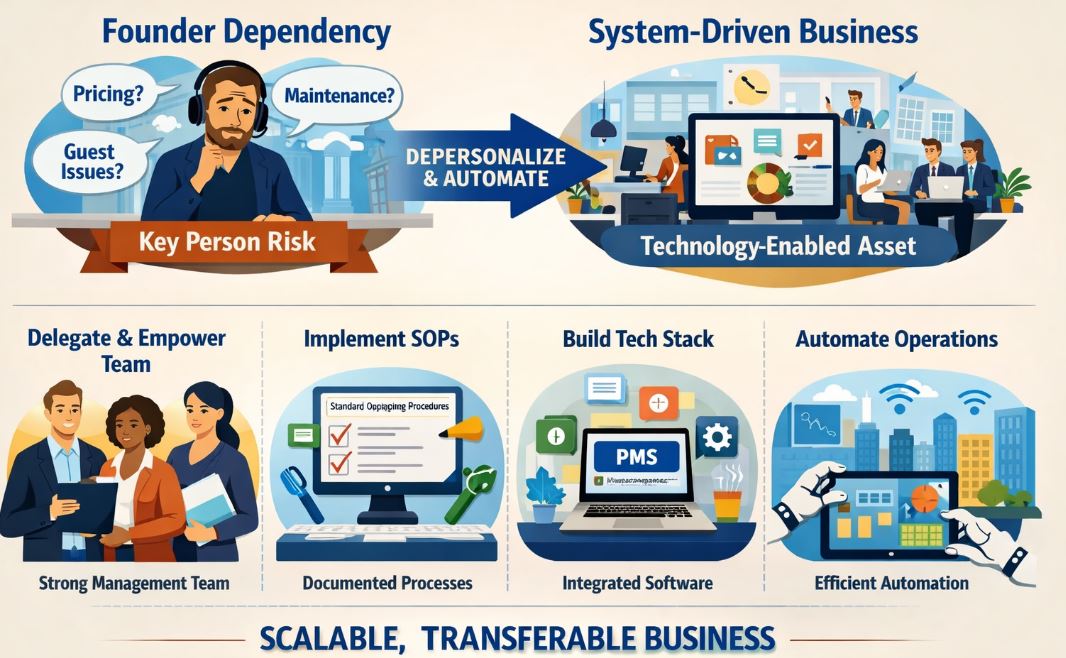
To transition from a founder-led business to a system-driven business, you must eliminate “founder dependency” (often viewed by buyers as key person risk) and transform your operation into a “technology-enabled asset”. The goal is to build a depersonalized business that relies on documented, repeatable, and automated systems rather than the owner’s daily judgment for tasks like maintenance, pricing, or guest complaints, thereby addressing the issues of Founder Dependency.
Here are the critical steps to execute this transition:
To effectively remove founder dependency, it is essential to delegate key roles within the organisation. This involves empowering capable team members to take on significant responsibilities, thereby reducing reliance on the founder’s direct involvement. Additionally, establishing clear processes and systems will enhance operational efficiency, making the business more attractive to potential buyers. By fostering a culture of accountability and utilising technology to streamline operations, the organisation can achieve sustainable growth independent of its founder.
Build a strong, transferable management team by delegating operational and homeowner-facing responsibilities. Appointing roles such as a general operations manager and a homeowner liaison enables you to step back from day-to-day operations and assume a strategic leadership position.
Implement Standard Operating Procedures (SOPs):
Establish digital SOPs for core functions like cleaning, maintenance, and guest access. This turns manual processes into automated, repeatable systems and creates a verifiable data trail proving that your company can uphold brand standards without your direct oversight.
Develop a Cohesive Technology Stack:
Center your business around a powerful Property Management System (PMS) and integrate software tools that actively eliminate workflow friction. You should seek out best-in-class software by consulting with industry peers rather than just software vendors.
Automate for Operational Density:
Shift from reactive, manual operations to predictable, tech-enabled workflows. By automating tasks such as guest access and validation, you can increase the number of units managed per staff member. This creates “operational density,” which decouples revenue growth from the need to linearly increase headcount.
By successfully implementing these steps, you stop functioning as a service-based, non-transferable job and evolve into a highly scalable, profitable business that can command a premium valuation in the M&A market
The content above was distilled from the M&A playbook.
