
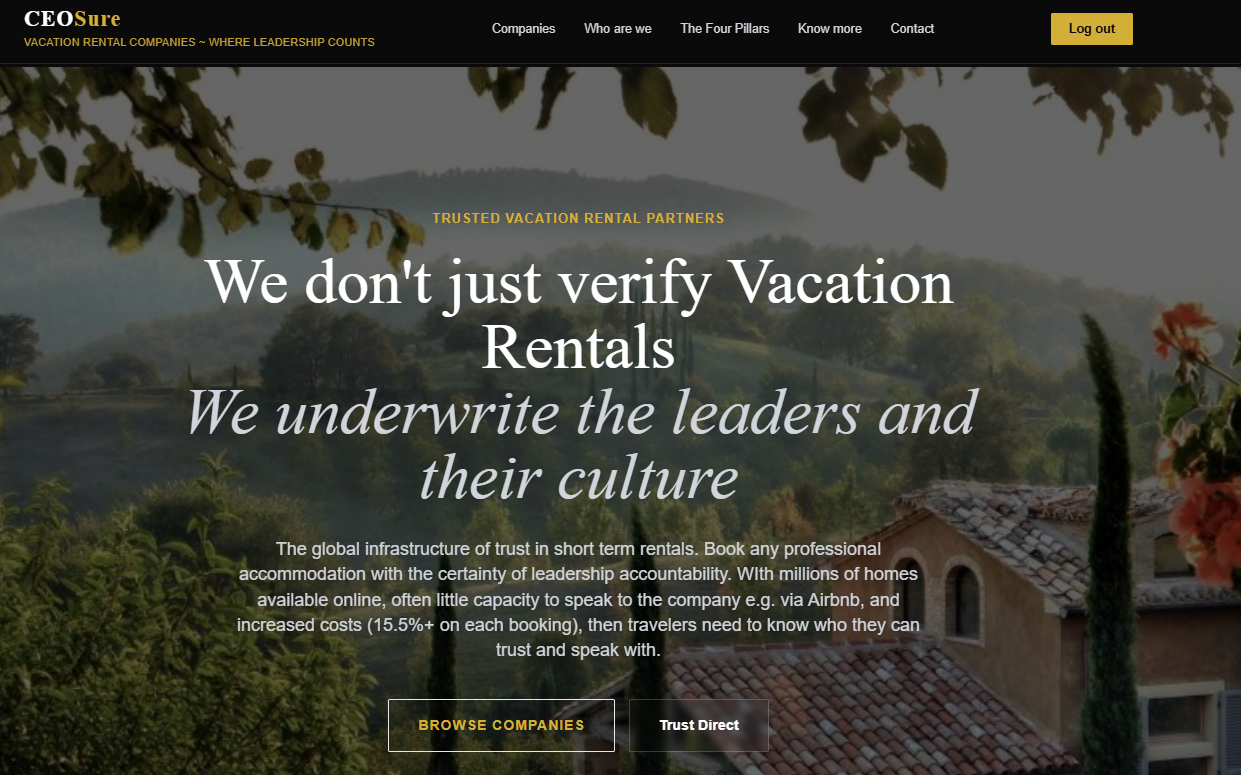
We have
We will be launching CEOSure soon, a platform designed to support leading companies in the industry and those aspiring to reach that level, the best of the best. Many organisations will see themselves reflected in the following text, as they experience varying degrees of success.
Our Elite Thesis
Identifying the top vacation rental companies is more complex than it appears. While visible indicators like OTA review scores, Superhost status, response rates, and website quality are often used, automated metrics, such as those used by Airbnb, do not capture the true nature of the business.
These metrics provide only a limited view. The vacation rental industry is highly fragmented, ranging from individual operators to large hospitality businesses managing extensive portfolios. Two companies may share a 4.9 review score yet differ significantly in professionalism, profitability, staff culture, operational resilience, and consistency in guest experience.
A major challenge is that many critical indicators are not publicly visible. Guests experience the final stay but seldom see the underlying operations.
A company may earn strong reviews while depending on founder intervention, excessive staff workloads, or reactive management. Conversely, another business may invest in systems, leadership, training, maintenance, and owner communication, resulting in a healthier and more scalable operation. These strengths are often difficult to observe externally, highlighting the difference between a company that simply functions and one that is truly well-built.
Most expect evaluations to focus on guest-facing metrics such as OTA review averages, review volume, repeat guest rates, cleanliness, communication scores, occupancy, pricing performance, and the quality of photography, branding, and digital presentation.
Guests are also paying more attention to trust indicators like response speed, transparent cancellation policies, professional communication, and public handling of issues in reviews. On platforms like Airbnb, Booking.com, and Vrbo, these signals have become highly influential.
The best of the best difference
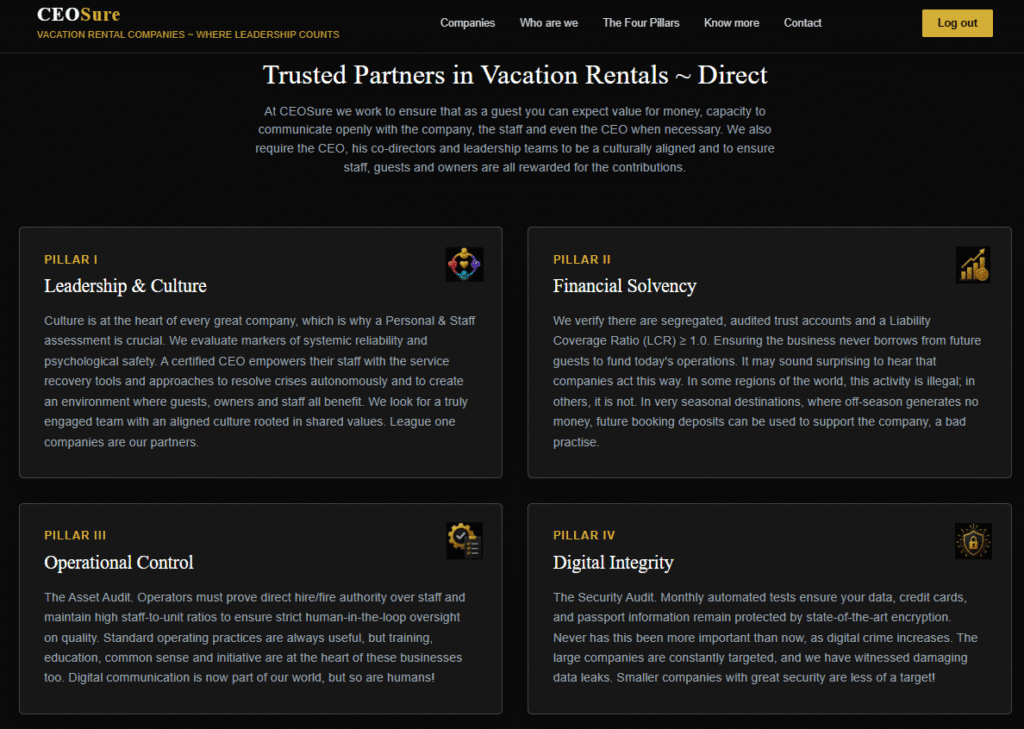
However, industry professionals and investors look for deeper operational and financial metrics to assess whether a company is truly elite. These include owner and staff retention, staff satisfaction, EBITDA margins, revenue per property, operational efficiency, maintenance response times, direct booking performance, OTA dependency, technology infrastructure, cybersecurity, SOP quality, leadership structure, and founder dependency risk. A company with excellent leadership, strong internal communication, and empowered staff will often deliver more consistent guest experiences over time than businesses driven purely by aggressive growth targets.
Defining the ‘best’ company depends on perspective. Guests value beautiful homes and excellent hospitality; homeowners prioritise revenue, transparency, property care, and communication; while investors focus on scalability, income quality, systems, and exit potential. Employees may look for leadership, culture, and career growth. Since the industry serves multiple stakeholders, ranking world-class operators requires balancing diverse qualitative and quantitative measures rather than relying solely on public review scores.
To identify truly exceptional vacation rental companies, it is necessary to look beyond vanity metrics and assess sustainability, operational discipline, cultural health, financial resilience, technological competence, and the ability to deliver trust at scale. This is far more challenging than simply finding the highest star rating.
Leadership is key
The primary factor distinguishing an average vacation rental company from an exceptional one is leadership, rather than technology, inventory size, or marketing spend.
In hospitality, culture reflects operationalised leadership. Standards, behaviours, priorities, and the emotional tone of a business typically originate from the founder, CEO, or senior leadership. This is especially important in vacation rentals, where success relies on coordinating many moving parts across people, properties, owners, guests, suppliers, and technology systems.
Many companies grow during favourable market conditions, but few maintain calm, trust, profitability, and consistency under pressure. The key difference is cultural maturity. Strong leaders ensure staff understand both what they do and why they do it.
Cleaners recognise the importance of guest psychology. Revenue managers consider the operational impact of occupancy strategies. Maintenance teams know that response speed affects trust and reputation. When culture is aligned, departments work together as a unified hospitality system rather than as isolated functions.
Culture eats strategy for breakfast.
This is why many respected hospitality brands are recognised for their culture before their product. While guests may book for a beautiful property, long-term reputation is built on consistency, accountability, communication, and trust. These qualities are rarely accidental.
Leadership decisions reinforce these qualities: how staff are treated, how mistakes are addressed, how owners are communicated with, whether long-term reputation is prioritised over short-term profit, and whether operational excellence is truly valued internally or only promoted externally.
In the vacation rental industry, there has often been a focus on growth metrics such as the number of listings, destinations, and revenue. However, scaling without a strong culture can create fragile businesses. Issues like inconsistent cleaning, staff burnout, poor owner communication, rising complaints, reactive management, and founder dependency may arise. While these businesses may appear successful externally due to review systems and marketplace visibility, internal instability makes them difficult to sustain.
In contrast, the strongest companies develop rich operational cultures where professionalism, accountability, learning, and hospitality excellence are embedded throughout the organisation, not just held by the founder.
Leadership establishes systems, empowers staff, promotes transparency, and builds resilience into the company. This foundation supports sustainability. Companies with healthy cultures retain staff longer, maintain strong owner relationships, deliver consistent guest experiences, and adapt effectively to economic or regulatory changes.
This is why investors and experienced acquirers increasingly examine leadership quality and culture during acquisitions. While financial performance is critical, sophisticated buyers also assess organisational health, founder dependency, staff turnover, operational maturity, communication, decision-making, and the company’s ability to thrive without constant leadership intervention. Culture, though hard to quantify, is a significant driver of long-term enterprise value.
Ultimately, the best vacation rental companies are defined not just by the properties they manage, but by the environments their leaders create. Exceptional CEOs and founders build organisations that are operationally disciplined, commercially ambitious, technologically capable, and hospitality-driven. In an industry built on trust and experience, culture is often the greatest determinant of world-class status.
