
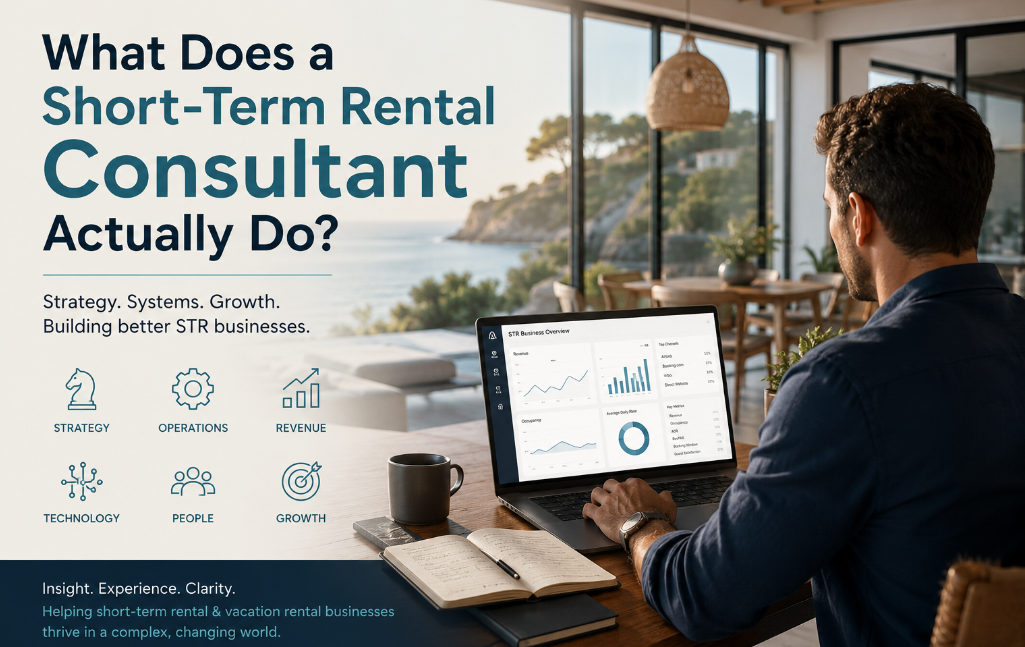
Short-term rental consultants and their industry have both matured dramatically over the last decade. What began as a fragmented ecosystem of independent holiday homeowners, local letting agents, classified websites, and small property managers has evolved into a highly competitive global hospitality sector defined by platform economics, AI, revenue science, regulation, investor capital, and increasingly sophisticated guest expectations.
Despite these advancements, the term “short-term rental consultant” remains unclear. Many businesses ranking for expressions such as “short-term rental consultant” or “vacation rental consulting” are not traditional consultants. They are often:
- Software companies
- Marketing agencies
- Direct booking website builders
- Revenue management providers
- OTA optimisation agencies
- Lead generation firms
- Brokers
- Influencer-style educators
- General hospitality advisors
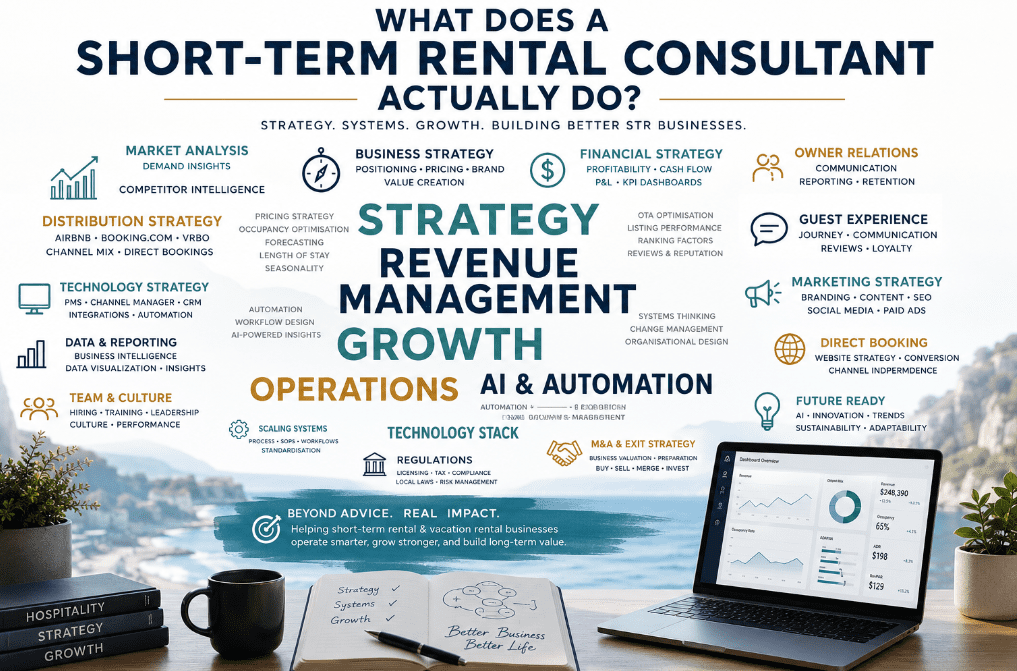
Each of these providers may offer value. However, true consultancy in the short-term and vacation rental industry is broader and significantly more strategic. A specialist Short Term Rental consultant operates at the intersection of hospitality, technology, finance, operations, leadership, distribution, revenue management, guest psychology, data, regulation, and increasingly, artificial intelligence.
In reality, the role is far closer to a fusion of:
- strategic advisor
- commercial architect
- operational analyst
- technology translator
- industry intelligence source
- and growth partner
Why Short-Term Rental Consultancies Exist
The short-term rental industry is unusually complex compared with many other sectors. Unlike hotels, most operators do not control standardised inventory. Unlike ecommerce businesses, the “product” is physical, local, operationally intensive, and highly emotional. Different from traditional real estate, revenue is dynamic and demand-sensitive. And unlike many mature industries, technology fragmentation remains extreme. A modern short-term rental operator may simultaneously rely on:
- OTAs such as Airbnb, Booking.com and Vrbo
- Property management systems
- Dynamic pricing software
- Channel managers
- Accounting tools
- Guest communication systems
- Smart locks
- Cleaning platforms
- AI tools
- Direct booking websites
- CRM systems
- Review management software
- Revenue intelligence systems
- Data dashboards
- Owner reporting tools
This often leads to operational complexity that appears as technological progress. Many businesses scale revenue without scaling structure. Many founders become trapped inside operational dependency. Many companies appear successful externally while inside suffering from:
- margin compression
- weak systems
- staff burnout
- OTA dependency
- poor data visibility
- fragmented technology stacks
- weak owner retention
- inconsistent guest experience
- or lack of strategic clarity
Specialist consultancy adds value in these situations.
The Difference Between a Real STR Consultant and a Generic Advisor
A general business consultant may understand leadership, finance, or organisational growth. A specialist short-term rental consultant understands the specific realities of the STR ecosystem. For example:
Distribution Complexity
A true STR consultant understands the commercial implications of:
- Airbnb fee structures
- Booking.com visibility algorithms
- OTA commission models and parity pressures
- direct booking economics
- channel conflict
- OTA parity pressures
- attribution challenges
- guest acquisition costs
This matters because the distribution strategy directly affects profitability.
Revenue Management
Revenue management in STR entails more than just “raising prices. It involves:
- demand forecasting
- length-of-stay controls
- occupancy pacing
- seasonal compression
- competitor analysis
- local events
- booking window behaviour
- channel mix
- and increasingly AI-assisted pricing systems
A specialist consultant understands how revenue strategy connects to operations, owner expectations, staffing, and long-term business value.
Technology Architecture
Many STR businesses operate with excessively complex and improvised technology structures:
multiple disconnected systems stitched together through manual processes and operational workarounds. A consultant specialising in STR technology should understand:
- PMS architecture
- API limitations
- data flow problems
- operational bottlenecks
- reporting fragmentation
- AI readiness
- automation risk
- guest communication systems
- and future interoperability
The industry is currently moving toward AI-native operational layers and “source of truth” architectures where operational intelligence becomes centralised rather than fragmented. This transition is likely to reshape the entire technology landscape over the next five years.
Modern Short-Term Rental Consultancy Is Increasingly About AI
Artificial intelligence is already transforming the vacation rental industry. Initially, AI adoption focused on:
- pricing
- guest messaging
- review summaries
- and marketing content
But the industry is now entering a second phase: AI-assisted operational orchestration. Forward-thinking operators are beginning to use AI to:
- analyse business performance
- monitor staff workflows
- identify operational anomalies
- optimise guest communication
- improve owner reporting
- generate strategic recommendations
- and unify disjointed data systems
The next generation of STR businesses will likely operate with:
- AI-assisted decision making
- conversational dashboards
- predictive operations
- and agentic workflows
This is changing the role of consultancy itself. The best consultants are no longer simply advisers. They increasingly act as translators between:
- hospitality
- operational reality
- human leadership
- and emerging AI capability
The Real Goal Is Not Growth. It Is Building a Better Business.
One of the biggest misconceptions in the vacation rental industry is that bigger automatically means better. This is not always the case. Many operators scale property count while:
- reducing margins
- growing operational chaos
- weakening culture
- and becoming increasingly dependent on founders
The strongest businesses are not necessarily the largest. The strongest businesses are usually:
- operationally disciplined
- financially structured
- technologically coherent
- culturally compatible
- and strategically intentional
These businesses regularly operate more calmly. They are more predictable. They are more resilient. They are more valuable, focusing not only on growth, but on creating:
- sustainability
- leadership maturity
- functional clarity
- and long-term enterprise value
Consultancy Is Increasingly Important as the Industry Professionalises
The short-term rental industry is entering a new era of professionalisation. Across Europe and globally, operators are facing:
- licensing requirements
- tax reporting frameworks
- platform regulation
- compliance obligations
- investor scrutiny
- labour pressure
- and increasing guest expectations
At the same time, institutional capital continues to enter the sector. The result is a growing divide between:
- hobbyist operators
- and professionally managed hospitality businesses
Consultancy becomes valuable amid this transition because many operators grew organically rather than strategically. They may have:
- strong local knowledge
- good hospitality instincts
- and excellent work ethic
but lack:
- governance
- systems
- scalable structure
- technology strategy
- leadership development
- or commercial planning
The role of consultancy is therefore not simply to “tell businesses what to do.” It is to help operators evolve.
What Should Businesses Look For in a Short-Term Rental Consultant?
Consultants vary in expertise and effectiveness. The best consultants in the STR industry usually possess a combination of:
- operational experience
- commercial understanding
- industry-specific knowledge
- strategic thinking
- and practical realism
Important questions include:
Have they actually operated businesses?
Consultants without operational experience may understand theory but lack insight into practical consequences. We have founded operated and exited both management and tech companies and we regularly talk at conferences, write articles for other platforms ………and for our own website.
Do they understand both hospitality and technology?
The modern STR industry increasingly sits between both worlds.
Can they discuss finance as well as marketing?
True consultancy requires commercial understanding, not just lead-generation tactics.
Do they understand AI and future technology shifts?
The industry is changing rapidly. Consultants who rely solely on outdated methods risk becoming obsolete.
Do they understand owner dynamics?
Property management businesses are unusual because operators often manage assets they do not own.
Can they discuss exit value and founder dependency?
Many operators eventually want to:
- sell
- merge
- recapitalise
- or decrease operational dependency
Very few consultants, and especially generic brokers truly understand how buyers evaluate STR businesses. Read our M&A Playbook
The Future of Short-Term Rental Consultancy
The next decade will likely transform the consultancy landscape. AI will reduce the value of generic advice. Basic marketing recommendations, content generation, pricing suggestions, and reporting will increasingly become automated. This means the value of human consultancy will shift toward:
- strategic interpretation
- experience
- systems thinking
- leadership
- commercial judgement
- and industry pattern recognition
The future consultant is less likely to be:
- a generic advisor
- or a motivational coach
and more likely to become:
- a strategic operating partner
- industry analyst
- AI translator
- and business architect
The businesses that succeed in the future will probably not be the ones with the most software. They will be the ones with:
- the clearest operational structure
- the strongest culture
- the best use of intelligence
- and the most coherent strategy
Final Thoughts
The short-term rental industry is no longer a niche side sector. It is now a global hospitality category determined by technology, regulation, behavioural economics, AI, platform dominance, and evolving guest expectations. As the industry matures, the role of consultancy becomes increasingly important. Not because operators lack ambition. But because modern STR businesses are becoming structurally complex.
A true short-term rental consultant should not simply provide advice. They should help businesses:
- think more clearly,
- operate more intelligently,
- structure more sustainably,
- adopt technology more strategically,
- and ultimately build more valuable hospitality companies.
That is the difference between simply running properties and building a beautiful business, such as those great vacation rental businesses found on CEOSure
