

Meta launched Muse on 8 September, and investors immediately began asking a question the travel industry has been avoiding: if a personal AI agent can research, compare and book a trip for me, what happens to the companies that currently sit between the guest and the accommodation?
Airbnb, Booking Holdings and Expedia have all suffered sharp share-price falls. That is a significant change in how investors price their future. It is not yet evidence that guests have abandoned them.
The more interesting question is whether the next gatekeeper will charge the old gatekeepers for access to the customers or send the guest directly to the provider.
What Muse Changes
Muse is Meta’s personal AI agent. Meta says it works in a dedicated virtual computer with a browser, can use connected apps, fill in forms and carry out tasks, and asks for approval before sensitive actions such as a purchase. People can communicate with it through its app or WhatsApp. For checkout, Meta describes integration with Stripe’s Link and a one-time-use card.
Meta’s advantage is potentially the point of entry: the agent can accompany a person as they make plans and act across websites. A guest might say, find a quiet place in Devon for four people and a dog, compare the full cost, check cancellation terms and book the best option. The agent can research several sellers, rather than wait for a person to visit a particular booking platform and this is why Muse has rattled travel stocks. The old guard has been challenged.
That is the threat investors are pricing. It does not follow that the agent will bypass an OTA. It might transact through Booking.com, Expedia or Airbnb if they offer the best combination of inventory, price, reliability and support. Expedia and Booking.com have already been early travel partners in ChatGPT. The new interface could send them customers, charge them for customers, or compete for the transaction.
The sell-off in context
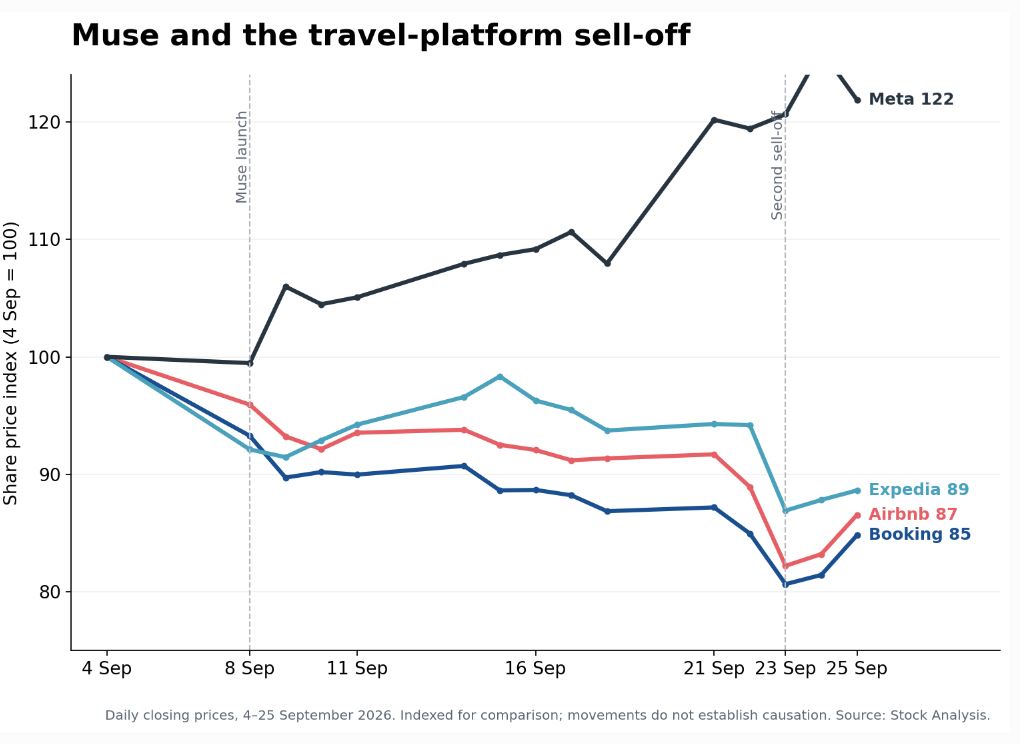
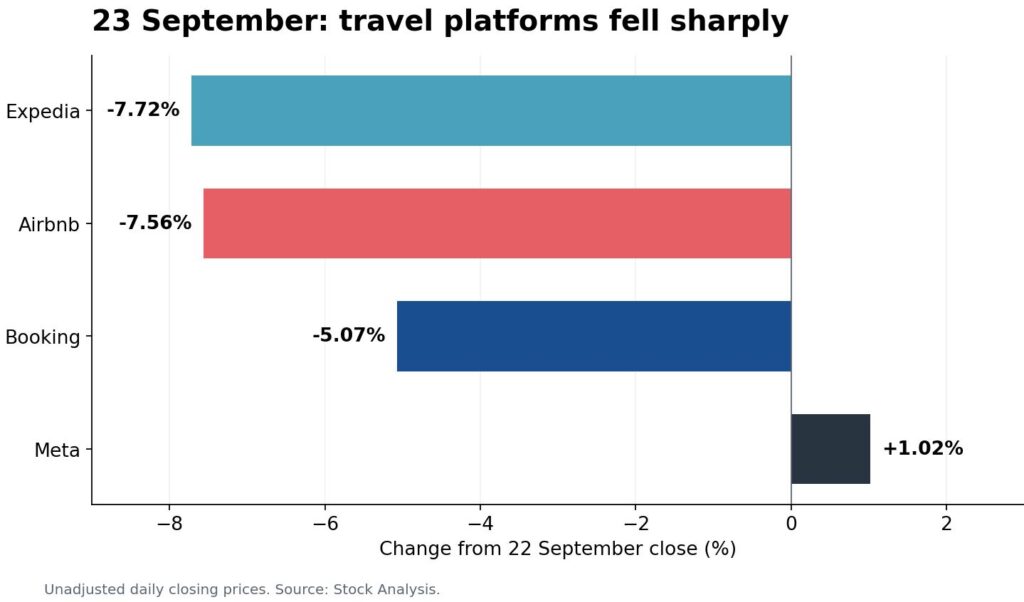
On 8 September, the day Muse launched, Expedia closed down 7.88%, Booking 6.72% and Airbnb 4.07%. There was another sharp fall on 23 September: Expedia fell 7.72%, Airbnb 7.56% and Booking 5.07%. Meta moved in the opposite direction over much of the period, though none of these price movements can be attributed to a single cause with certainty. The second episode followed news of Expedia working with Muse.
This was the second substantial AI scare for travel stocks in 2026. A February hypothetical disruption scenario also coincided with one-day declines of roughly 6-8% among the major booking platforms. Markets are repeatedly revisiting the same question: who controls the customer when a capable agent becomes the starting point?
Discovery is moving faster than booking
There is evidence that the research stage is changing. Phocuswright reports that general search engines fell from 51% in mid-2024 to 36% in late 2025 as travellers most-used travel research resource. It also reports growing use of AI in trip planning. That finding tells us where more journeys may begin; it does not tell us where the booking is completed.
Nicolas Sitter’s analysis of a panel of more than 17,000 hotel websites found a 62% step up in daily AI referrals after ChatGPT began placing hotel website links directly into answers in May. But AI referrals rose from only about 0.64% to 0.92% of all sessions around that change. The relative growth is impressive; the absolute share remains small. Nor is a visit to a hotel website the same as a reservation.
The guest is a further constraint. In a YouGov survey commissioned by Expedia Group before Muse launched, 68% preferred to book through a trusted travel brand rather than an AI agent, 66% said they would not trust an assistant to purchase or book on their behalf, and only 8% felt comfortable booking through an AI platform. These are stated preferences, and behaviour can change. Today they suggest that trust, payment, changes and after-sales support are commercial assets, not merely technical steps to automate.
Meanwhile Airbnb reported 10% year-on-year growth in nights and seats booked and 16% growth in gross booking value for Q2 2026. Those results precede Muse; they provide a useful baseline, not proof that the new threat is harmless.
Where the money could move
I think the immediate commercial risk is to **customer acquisition cost and margin**. An agent that controls the guest’s first conversation may demand a fee for introducing a booking. The OTA might retain the booking, payment and support but pay another party for access to the customer. That could replace part of its spending on search advertising or add a new cost on top.
Agents might also make price differences easier to see. A persistent assistant can check a member rate, a package, cleaning and pet fees, cancellation terms and the provider’s direct site in the same search. That could weaken pricing tactics that rely on travellers not making a thorough comparison. It is my inference about likely behaviour, rather than a measured margin effect today.
The more disruptive scenario is an agent completing a booking with the hotel or property manager directly. That would threaten OTA volume as well as margin. But it requires accurate availability, an all-in price, a reliable checkout, clear policies and someone accountable when the guest needs help. Those capabilities cannot be inferred from a nicely structured property page alone.
The short-term rental complication
Airbnb has a stronger defence than a generic hotel reseller: many individual hosts and guests use its marketplace, reviews, payment system and protections because they trust the full transaction. But the inventory is exclusive is too broad a claim.
Many professionally managed homes appear on multiple OTAs and have a direct booking route. If an agent can identify the *same property* elsewhere and complete a cheaper, equally trusted booking, the manager may recover the guest relationship.
This is particularly relevant to operators who have spent years building direct distribution. Their problem has rarely been a shortage of website pages. It has been being discovered, returning a trustworthy live price, converting the guest and providing support. An AI agent may make those strengths more valuable, but it may also establish a new intermediary with its own fees and rules.
For a manager, the practical work is straightforward: keep property facts and policies accurate; make the complete price and live availability accessible; offer a secure, workable direct checkout; measure referrals, completed bookings and acquisition cost by source; and ensure the PMS can safely connect to external systems under the manager’s control. An open API helps, but no single schema tag or MCP server guarantees inclusion in an agent’s recommendations.
Will it finally happen?
Are we seeing a real and new discovery layer that can develop into a panacea for large commission charges and a move back to reasonable marketing costs.
We are looking at a huge opportunity: A permissioned accommodation distribution layer for member organisations: searchable supply, verified eligibility, live total prices, booking or handoff, and clear attribution.
The hard part would be ensuring that the offers are genuinely better or more relevant and secure.
Imagine “sign your agent in to your private member travel site”, this is a compelling scenario. Agents can make existing private programmes more effective. The big change comes in these programmes when inventory is sourced and fulfils stays directly from operators at scale. That is when they become a real alternative route around OTA distribution, rather than a new front end for it.
We are seeing more technical opportunities that open up inventory and third-party promoters globally. MCP and UCP are key acronyms, and making waves on discovery and transactions. Not for discussion here, but we are on the cusp of some big changes.
Big is Beautiful
Aggregation is vital to customer choice, for Amazon they layered on delivery and storage and played to human’s desire for energy efficiency, commonly known as laziness. They have also banned LLMs from diluting their own massive silo. STR is not a standardised product and still very fragmented in distribution and geographies. This article explains more about why OTAs can’t own the warehouse. Guests want choice and this has always been the starting gambit, before applying financial and data control pressures.
Discovery is changing, aggregation will be next and offers further opportunities for exposure. Its expensive and big money is chasing the next winner. Don’t expect a free breakfast, just hope the meal looks different and comes with all the condiments and is affordable!
How Will Bookings Convert?
It is time however to think conversion as the transaction may not take place on the discovery platform but on your own website or even DMO or another global aggregated inventory platform. This could be accelerated with third party payment and guest risk/insurance platforms providing that all important layer of security and peace of mind. This means tech, knowledge, good partners and investment in the future.
What would prove the change is real?
Over the next few quarters, we should all watch completed bookings attributed to AI agents, not just prompts, mentions or clicks. Also, we should watch whether OTA marketing costs rise or fall per booking, what agents charge for a referral or transaction, and whether independent hotels and professional rental managers achieve a measurable increase in profitable direct booking.
The share-price reaction is real. A change in discovery is emerging. The transfer of bookings and margins remains an open question.
My view: As we can see Muse has rattled travel stocks but the next contest in travel is over who the guest asks first, who can fulfil that request reliably and who is paid for the introduction. The old platforms may survive it very well. They may simply discover that someone else now owns the front door.
Sources and chart notes
Meta: Introducing Muse, 8 September 2026 (https://about.fb.com/news/2026/09/introducing-muse-personal-ai-agent
– [Phocuswright: Travel Innovation and Technology Trends 2026] (https://www.phocuswright.com/Travel-Research/Research-Updates/2026/Report-Preview-Phocuswrights-Travel-Innovation-and-Technology-Trends-2026)
Simply Wall St: Airbnb and AI travel booking concerns (https://simplywall.st/stocks/us/consumer-services/nasdaq-abnb/airbnb/news/how-ai-travel-booking-concerns-will-impact-airbnb-stock-inve)
– [Nicolas Sitter / The Hotels Network: ChatGPT hotel website referrals] (https://www.nicolassitter.com/research/chatgpt-hotel-direct-traffic-explosion-2026)
– [Expedia Group / YouGov: The AI Trust Gap, April 2026] (https://ir.expediagroup.com/news-and-events/news/news-details/2026/Expedia-Group-Reveals-The-AI-Trust-Gap-Travelers-Embrace-AI-for-Planning-but-Rely-on-Trusted-Brands-to-Book/)
One for later on OTAs: “Airbnb (and OTAs) can’t own the warehouse either“
