
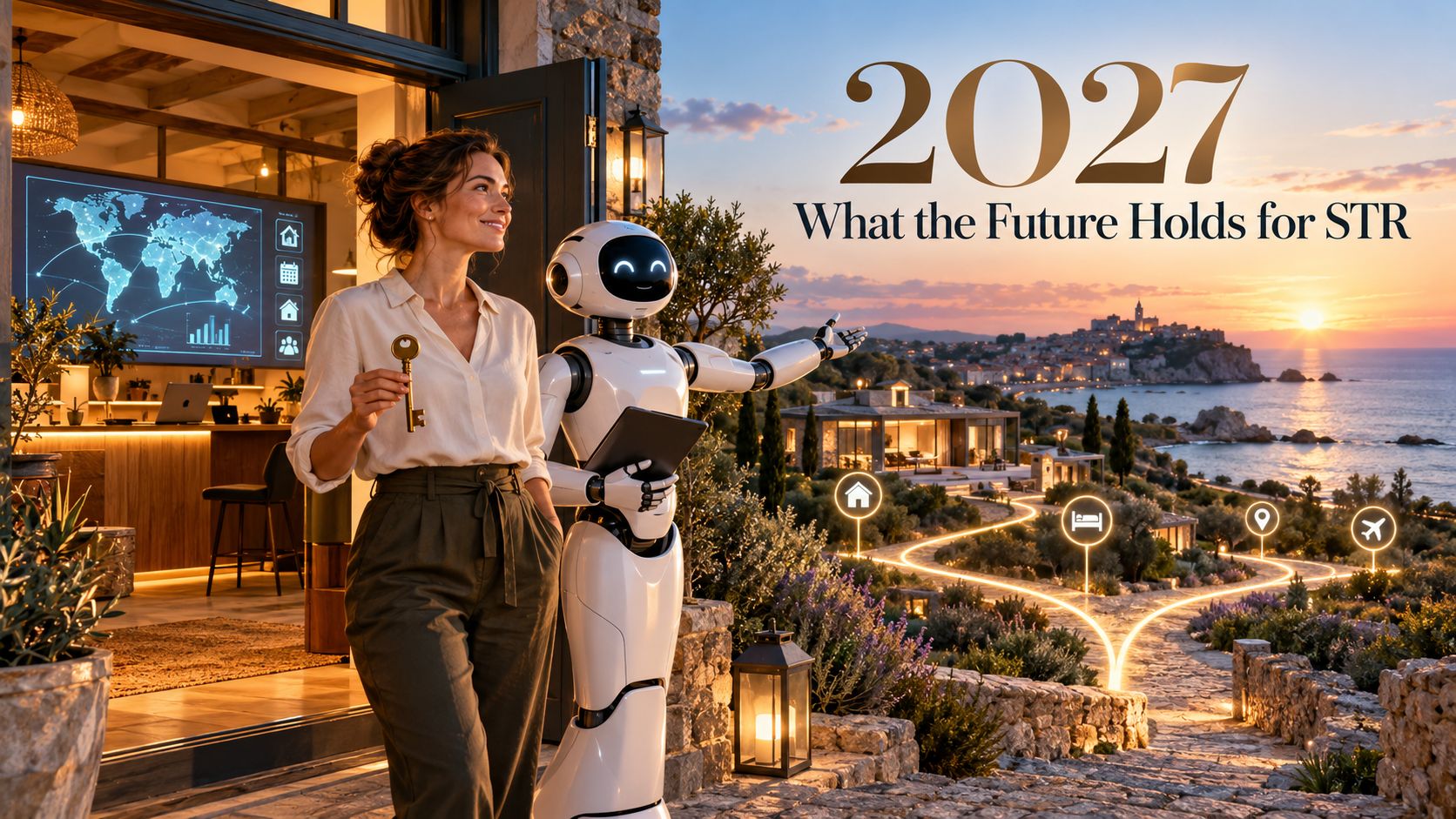
As a board advisor to technology businesses and property management companies, I am privileged to see the short-term rental industry from several angles. Conversations move between software, operations, investment, owners, guests and the people trying to make all these moving parts work together.
Part of that role is to question what comes next. Where are the opportunities? Which business models are becoming vulnerable? Where is investment heading? And which apparently exciting developments will actually improve a rental company’s performance?
I believe we are approaching another major turning point.
Over the past quarter-century, the internet has changed how accommodation is discovered, distributed, and booked. Covid disrupted demand, accelerated digital adoption and exposed weaknesses in businesses that had confused rapid expansion with durable success. AI now introduces another change: software that can interpret information, recommend decisions and increasingly act on them.
These forces have different origins, but their consequences overlap. Together, they are changing the cost of running a business, the value of its data and the relationships through which bookings arrive.
Between now and the New Year, I will publish four articles examining where this could take us: humanoid robots, the future of the PMS, and the relationship between AI agents and OTAs and how the world is facing up to security of any information as more and more companies are hacked.
AI runs through all three. The questions I want to explore are commercial and practical: what becomes possible, who benefits, who becomes dependent, and where does the margin go?
First, a little context: growth meets reality
The pandemic years combined cheap capital, rapid changes in consumer behaviour and an acute need for digital tools. In parts of the market, investors funded expansion assuming exceptional growth would continue. The subsequent reset exposed the difference between a business that could grow and one that could sustain itself.
For rental operators, the underlying questions were stubbornly familiar. What does each property contribute after the real costs of servicing it? Do owners stay? Do guests return? Does adding inventory improve profitability or add complexity?
Technology businesses face their own version of the same test. Does the software create enough value to retain customers, cover its costs, and justify further investment?
AI adds a new tension. It may reduce the cost of developing software and performing certain tasks, while also making it easier to launch competing products. More software does not automatically mean better businesses. More automation does not remove the need for sound architecture, reliable operations or accountability. That is the backdrop to this series.
Please feel free to sign up to the free substack mailing list. These reports are not for paid subscriptions and available to all on mailing and posted here later.
1. The PMS: one system, many systems. Or one intelligence layer?
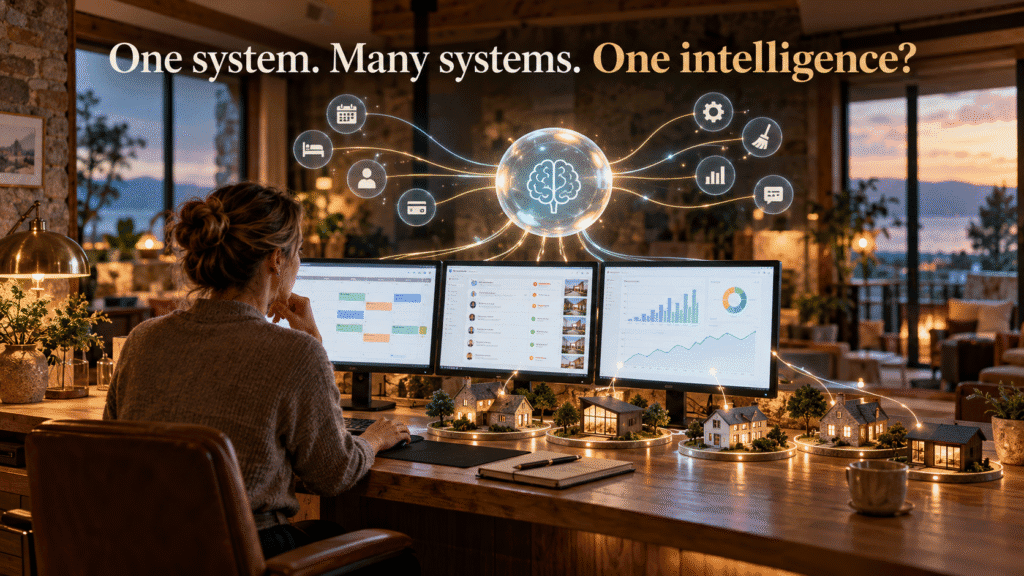
The PMS debate is often presented as a choice between an all-in-one platform and a collection of specialist tools. That raises several important questions.
One supplier is not necessarily one database. One database is not necessarily one coherent view of the business. An intelligence layer could coordinate several systems without replacing them all.
Managers need flexibility because rental businesses differ. Their contracts, service models, markets, properties and ambitions are rarely identical. They also need dependable workflows and a clear understanding of performance. The commercial challenge is to provide both without adding cost, complexity, or dependence.
This article will examine why PMSS businesses attract investment, why suppliers expand into adjacent services, and how AI could change the relationship between the system holding information and the system making decisions. Who can access the data? Who can interpret it? Who has permission to act? And how easily can the manager change suppliers?
Disclaimer: I advise Boom, and I will make that involvement explicit. I will explain the approach I support and the reasons behind it, alongside the alternatives and their trade-offs.
The measure throughout will be the same: does the technology help the manager build a more profitable, knowledgeable and strong business?
2. AI agents and OTAs: who controls the booking?
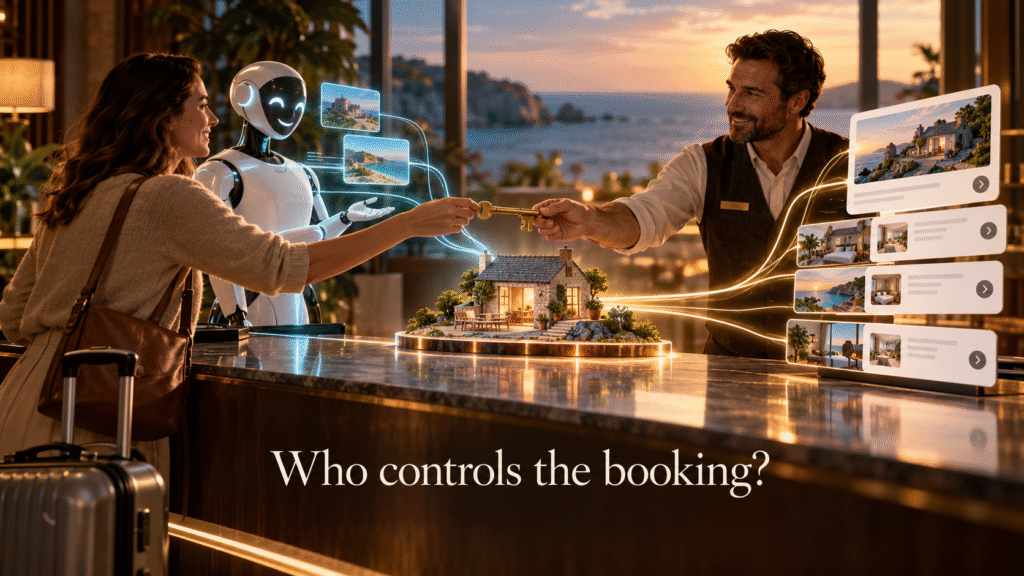
AI agents introduce the possibility of a traveller describing what they need and delegating more of the work of finding and booking it. For accommodation businesses, that raises questions that go far beyond a new source of website traffic.
Who selects the shortlist? Which inventory can the agent access? Where does it obtain prices and availability? Who takes payment, manages changes and accepts responsibility when something goes wrong?
An agent could become a new route to the guest. It could also become another intermediary with its own fees, preferences and commercial incentives.
OTAs have substantial advantages in this environment: inventory, transaction infrastructure, customer support and established supplier relationships. They may operate their own agents, supply other agents or fulfil bookings initiated elsewhere.
Independent operators have opportunities too, but being discoverable is only one part of the job. Accurate property information, live availability, clear terms, secure payments and reliable reservation procedures all matter. This article will examine how those pieces might come together, and what the changes could mean for direct bookings.
I will look for evidence in completed transactions and profitable demand. Planning conversations, referral traffic and impressive demonstrations tell only part of the story. For the manager, the central question is whether a new channel improves access to guests on sustainable terms, or creates another dependency.
3. Security: the next product category in short-term rentals?
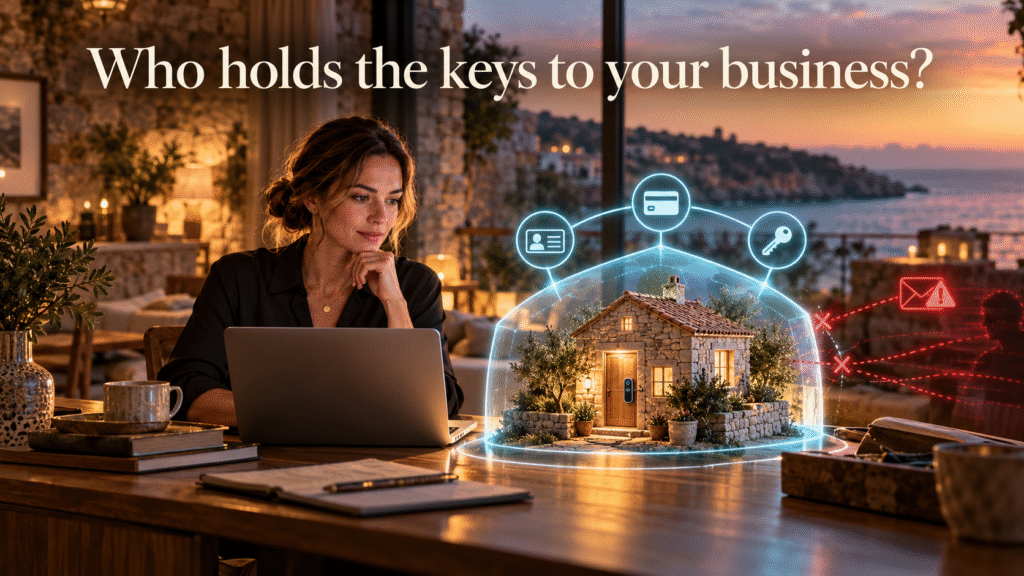
Every new connection creates an opportunity. It also creates another point of exposure.
Rental businesses increasingly depend on interconnected PMSs, channel managers, payment services, check-in tools and guest-messaging platforms. Managers can run their own operations carefully and still be exposed through a supplier, an integration or a compromised account.
The consequences extend beyond stolen data. A fraudulent message containing the guest’s actual booking details can make a payment scam look convincing. Access to door codes can turn a digital breach into a physical security problem. An AI assistant authorised to send messages, change reservations or issue refunds introduces further questions about permissions and control.
As software becomes easier to build, these questions become more pressing. A working demonstration tells us little about whether a tool can safely handle guest information, payments or access to a property.
I expect security to become a more visible commercial category in short-term rentals, with suppliers selling protection, independent assessments, monitoring, training, and incident support specifically for our industry. Some offers will provide meaningful protection. Others will package basic precautions in reassuring language.
This article examines how managers can tell the difference, what evidence to request from suppliers, and when independent expertise is necessary. It also explores the responsibilities of businesses building their own AI tools or buying them from developers whose security capabilities may be hard to assess. Certifications and security features matter, but protection also depends on architecture, implementation, maintenance and the people using the system.
For managers, the practical question is straightforward: as more systems gain access to the business, how do you establish what they can do, who is accountable, and what happens when something goes wrong?
4. Humanoid robots: when intelligence enters the property
This one may seem off the wall to a degree, but we should all ignore it at our peril, as the first line of defence against bad reviews and mid season staff challenges is cleaners. Humans may well be replaced completely in half a century, but imagine one that cleans and tidies, never gets sick, and arrives on time, and follows all your instructions.

Much of the discussion about AI in rentals happens on a screen: messaging, pricing, content, reporting and customer service. But somebody still has to change the beds and a cleaner is one of the most important but oft inconsistent parts of this complex business. They are humans and humans are fragile.
Properties require cleaning, inspection, maintenance and physical preparation. They contain stairs, awkward bathrooms, fragile objects and an almost unlimited variety of layouts. These are difficult environments for machines.
That makes robotics easy to dismiss. A robot moving cautiously through a demonstration can seem a long way from completing a Saturday changeover. Yet the direction deserves serious attention.
My own experience has taught me to watch what happens when hardware, computing and accumulated data begin to reinforce one another. Early limitations can be real without being permanent. The harder question is how quickly improvements become commercially useful.
This article examines both sides: the advances that could bring robots into hospitality, and the operational obstacles promotional videos leave out. Humanoid machines will also need to compete with simpler, specialised equipment. Looking human is useful only if it helps the machine perform the work.
For managers, the relevant test is clear: can it complete a useful task safely, consistently and at an acceptable total cost? I will explore what is seeing attention during 2027, what is still speculative, and why developments now could influence the industry well beyond the coming year.
What this means for 2027
These articles will distinguish what is already useful, what deserves preparation, and what remains a longer-term possibility. Each will finish with practical consequences for managers: what to examine, what to ask suppliers and which developments might justify a change in direction.
My views simply draw on experience, conversations, research and the movement of investment. They remain opinions, open to challenge as the evidence develops. Across all three subjects, I will return to one question:
As technology takes on more of the work, which decisions must a rental business retain control over to protect its profitability, independence and character
Please sign up for the free subscription to receive these articles.
