But Needs More Data
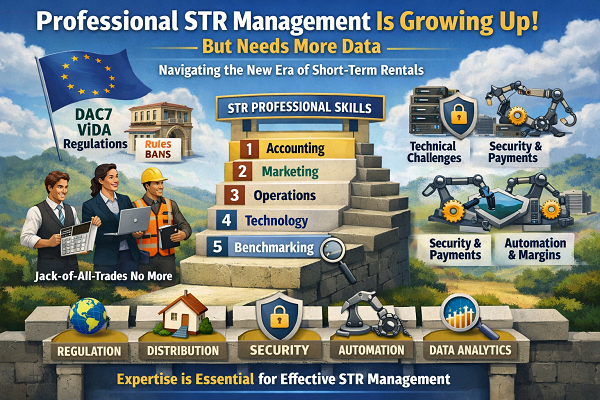
We are moving into the next epoch of STRs, with governance and regulation at all levels now being witnessed. For example DAC7, the latest verdict on ViDA by the EU, licensing, registration outright bans and regulations across the globe. Add in technical challenges on distribution, security issues on transactions, automation to ensure margin support and many STRs need to grow up and professionalise, quickly. This evolution is crucial for effective STR Management.
There are a few qualifications for becoming a Vacation Rental/Short-Term Rental (VR) professional. There are many skills that can add value to a team, including accounting, marketing, and operational skills, such as engineering, HR, and IT. Virtually no one has all these attributes at depth. These skills are invariably adopted piecemeal, and often when there are business challenges, but it is increasingly important to focus on all aspects of the business.
To navigate this complex landscape, a deep understanding of STR Management is essential for success.
Most managers have long been a jack-of-all-trades, relying on external expertise to assist in these disciplines, but change is here and expertise is needed and as illustrated at point 5, moree benchmarking is needed.
1. Work Backwards First!
How times have changed! There are some very clear trends, and the need to work backwards from profit to properties has never been so important.
All businesses work on margins: “Gross Booking Values” minus “Cost of Sales,” then subtract all other costs; the remainder is your income. There are lots of financial manipulations attached to the numbers, of course, but this is the very simple approach and your air supply.
It is amazing how many managers do not know their income, how much cash is actually theirs at any one time, or whether they can survive the quiet periods or downturns. They do not know the market, their competitors, their business cost structures, leakage, marketing performance, or any of the core metrics. Business Intelligence is becoming critical.
Most businesses started with people who had an entrepreneurial spirit and hard working ethic, and fell into the VR trap of being so busy they couldn’t come up for air or look at the horizon.
With increasing administrative, legislative, and staff costs, and marketing flux, working backwards makes so much sense. Work from a position of comfort on your desired (and sensible) income, with a balance sheet buffer to carry you through downturns, ensuring a similar level of staff comfort and therefore stability, all makes sense.
Try it to ascertain whether it is feasible to develop a business that does not crush your soul and may be positioned to sell when that day comes. This allows you to build a strategy and highlights the need for continuous financial monitoring.
2. AI powers tools, its not a complete solution (yet)
The Internet is alive with companies offering you solutions and often to problems that don’t exist. The ability to be a back-end programmer or a no-code developer using tools such as Replit or Basecamp allows all of us to create internal tools and even MVPs for business models. But a Vibe-coded or poorly designed product without a secure, multitenanted, and scalable architecture is not a product to adopt when you rely on all the dots being joined up seamlessly between booking and departure.
New apps everywhere
We are witnessing an avalanche of apps and AI tools seeking an income-generating home. Managers with larger portfolios are identified as ideal targets and a shortcut to recurring revenue. Managers expect dynamic data exchange, not manual processing. Hence, professionals use the industry gatekeepers: PMS systems, to manage inbound and outbound data, financial information and booking flows. They are the ultimate source of truth for bookings, pricing and properties and the best are AI native, with the capacity to harnessing all data and complete the toolset.
Connectivity is incredibly important for accessing a large inventory and is possible through a single normalised PMS channel, such as Calry. For these new Saas companies, entering the market is even easier with AI coding, but the major expenses are marketing, support, and ongoing development, if the plan is to see a substantial exit.
Then there is the question of longevity and the goals of well-funded big businesses, which will inevitably control the majority of the ecosystem and compete with their integrated partners.
“Choose wisely, young padawan”
Is quite an appropriate quote for new and even experienced managers on new Saas products.
3. Marketing & Distribution is a Science
Marketing covers a whole range of skills and technical requirements and in STR is twice as tough as in many other industries: Acquiring guests and acquiring (and retaining) owners. OTAs have also gained a few percentage points over the last 12 months and, despite the endless “Book Direct” campaigns, continue to extract their “taxes” for exposure and bookings.
To be Direct?
Is it better to invest in direct bookings? Just having a website is pointless; you need to work on traffic, engagement, design, content and conversions. Add social media, newsletters, in-booking and post-booking engagement, and that raises the question: How much effort is involved, and how are the success steps measured?
De-risking via a multi-pronged approach is a good strategy and different classes of visitors (e.g., mid-term stays) also add value, but all require work, marketing exposure, and often increased distribution. With so many tools available, it is clear that successful businesses know how to interpret their website traffic, revenue management, and social media engagement and strike the right balance at top of the sales funnel.
However, as Peter Drucker notes, few managers allocate sufficient resources to these desired outcomes and the tools they subscribe to.
“If you can’t measure it, you can’t improve it.
4. Big is Beautiful by Numbers
The press loves bad news. This is why we witness meltdowns in large-scale businesses, most recently, Vacasa’s drop in value from over $1bn to $160m, and Sonder’s lack of risk analysis on real estate costs and its subsequent liquidation.
However, if we look closely at some of the big businesses in our industry, you will see that they make over EU/$50K per employee (before taxes etc), on run-of-the-mill volume inventory and circa EU/£3.5K per property. Higher-value property portfolios, edging into larger groups and luxury portfolios, earn substantially more per property and staff member. If you think this is impressive, each Airbnb employee contributes over $500K based on adjusted EBITDA!
How much does your company earn per property/employee? Most managers can’t tell you!
Large companies are winning their own marketing games on Search and have the capacity to invest in technology and understand and evaluate the successes and failures of their actions. They have the cash available due to their machine driven approach based on Business Intelligence. Many quote poor service, poor quality, poor everything about these large companies but is your EBITDA over 30%?
Private equity has invested in many of these companies and is cherry-picking the cream of the acquirable businesses, aiming to increase the purchase multiple per business on exit. Times have changed, however, and those who sell need to be both prepared and performing.
5. Benchmarking Data is Important
Companies need to benchmark their data and understand what a healthy company looks like. There are so many business models, from urban, full service, OTA reliant, small apartments distributed over miles, to small portfolios of high value, high quality, 100% direct, sub-contracted service businesses and many in between.
There is plenty of pricing data as it can be scraped or accessed via PMS systems, but there is little data on revenue per staff member, how much is spent on marketing or tech for example. We can see a lot of this data in public companies but private concerns are constricted by the diversity and lack of reporting metrics.
There are many businesses which mint money and many which miss money.There are no publicly available websites to review the comparisons of each discipline that make up the fabric of a successful business.
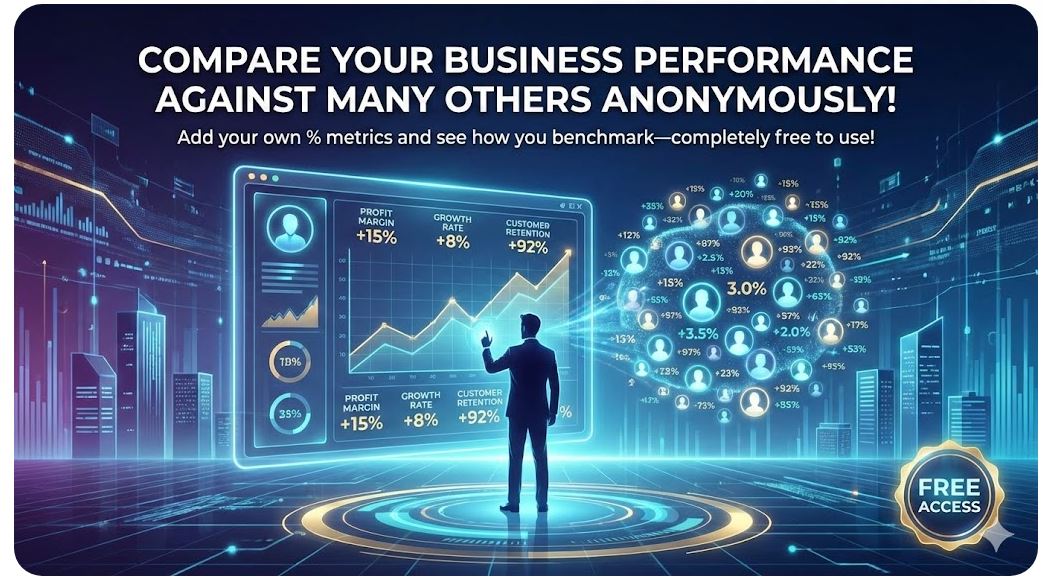
We are creating an environment, based purely on revenue percentage comparisons. We have some hundreds already and are inviting others to contribute anonymously and see where they sit in the % spend eco-system. No financial data is needed and all is anonymised and registration information is very limited.