
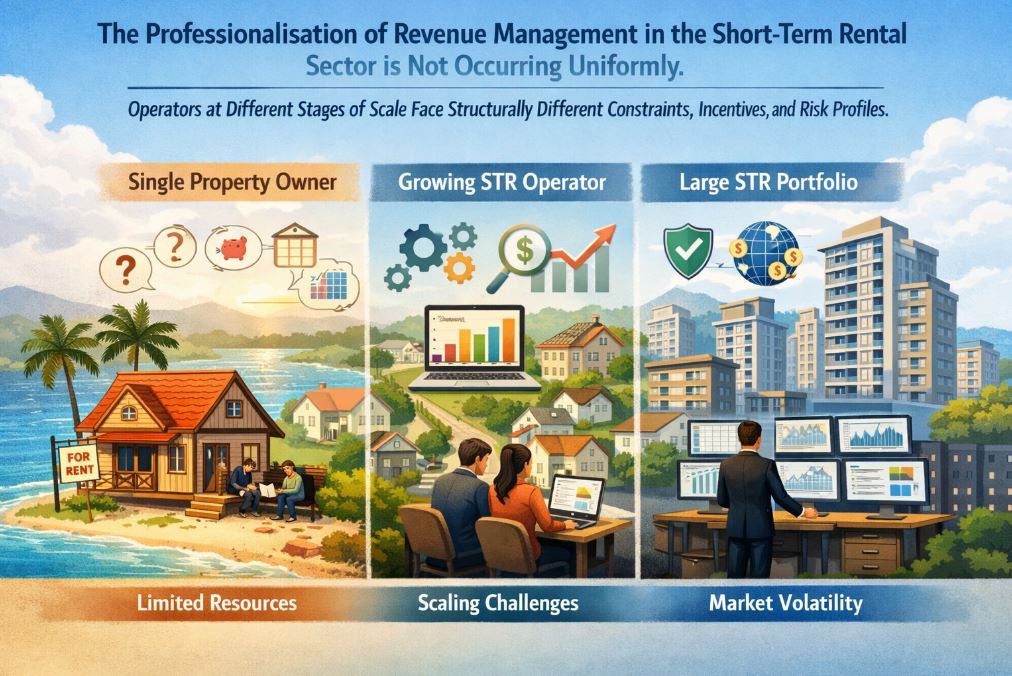
The professionalisation of revenue management in the short-term rental (STR) sector is not occurring uniformly. Operators at different stages of scale face structurally different constraints, incentives, and risk profiles. As such, revenue management strategy needs to be segmented by organisational maturity, not merely by portfolio size. With so many operators struggling to reach 100 properties and generally in the 30-60 range, revenue management is tough to be on top of and human factors, not logic, can apply.
We have recently launched a free service for revenue managers, revenue management companies, and revenue and data businesses that offer software and SaaS tools. This website is under RevenueManagers.co

We asked a Revenue Manager for some basic advice, which is shown below. Our advisor has offered a tiered framework for small, mid-sized, and institutional STR operators, with explicit strategic priorities and actionable revenue management approaches for each.
1. Small Operators (1–50 Properties): Survival, Signal, and Skill
Small operators typically sit at the intersection of owner-operator behaviour and emerging professional practice. Revenue management is often handled by the founder, alongside operations, guest communication, and maintenance. The principal risk at this level is not tool underperformance, but underutilisation of data and over-reliance on intuition.
Strategic Reality
Small operators operate in an environment of:
-
High emotional attachment to assets
-
Low tolerance for vacancy risk
-
Limited analytical capacity
-
Strong behavioural bias (panic discounting, overpricing sentiment, etc.)
The most common failure mode is static pricing disguised as dynamic behaviour.
Actionable Revenue Management Priorities
1.1 Eliminate Static Thinking
The first and most critical shift is moving from seasonal bands to true daily pricing logic.
-
Abandon “high/mid/low” seasons.
-
Use tools such as PriceLabs or Wheelhouse in full automation mode, not as advisory dashboards. Note: We would not advise this on high-value or premium accommodation or destinations where data is scarce.
-
Set minimums, maximums, and base prices, then let algorithms operate.
At this level, automation is not a luxury; it is a risk control mechanism.
1.2 Focus on Gap Value, Not Just ADR
Small portfolios are disproportionately impacted by:
-
1–2 night gaps
-
orphan nights between bookings
-
poor arrival/departure alignment
Revenue managers (or owner-managers) should:
-
aggressively price gaps,
-
enable short stays (management considerations needed)
-
and apply last-minute premiums, not just discounts.
This often delivers more uplift than broad ADR increases.
1.3 Treat Reviews as Revenue Assets
For small operators, review score is the single greatest pricing lever.
-
Target 4.8+ as a commercial objective, not a vanity metric. This is often overlooked and should be looked at through a different lens. Ask a friend!
-
Invest in:
-
professional photography,
-
welcome packs,
-
proactive guest comms,
-
and issue resolution.
-
In small portfolios, quality upgrades typically outperform pricing tweaks. This is revenue management through product enhancement, not price manipulation.
1.4 Behavioural Discipline Over Analytical Complexity
The greatest challenge is not data – it is emotional interference, as with most things in STR!
Key behavioural rules:
-
No discounting before 14 days out.
-
No price changes driven by “feeling quiet”.
-
No overriding algorithms without evidence.
At this level, discipline produces more value than sophistication.
2. Mid-Sized Operators (50–200 Properties): Structure, Segmentation, and Scalability
Mid-sized operators sit in the most dangerous zone: Too large for intuition, too small for institutional process. This is where margin leakage is greatest and strategic drift most common.
Strategic Reality
Mid-sized operators typically exhibit:
-
fragmented portfolios (locations, asset types, contract structures),
-
inconsistent owner expectations,
-
growing staffing overhead,
-
and increasing dependence on OTAs.
Revenue management failures at this level are rarely due to ignorance; they are due to a lack of architecture.
Actionable Revenue Management Priorities
2.1 Portfolio Segmentation Is Non-Negotiable
The single biggest uplift opportunity is portfolio stratification.
Revenue managers must segment by:
-
asset type (apartment, villa, lodge, etc.)
-
location micro-market
-
contract type (guarantee, commission, hybrid)
-
owner usage patterns
-
review score band
Each segment must have:
-
its own base price logic,
-
its own min/max constraints,
-
and its own elasticity assumptions.
Treating a mixed portfolio as homogeneous is one of the most expensive mistakes.
2.2 Introduce LOS and Arrival Pattern Strategy
At this scale, revenue management must move beyond “price per night” and into “pattern engineering”.
Key actions:
-
Set minimum stays dynamically by season and lead time.
-
Apply premiums to high-value arrival days (e.g. Fridays in leisure markets).
-
Use discounts strategically to shift demand into low-value gaps.
This is where revenue management begins to resemble airline yield logic.
2.3 Build Pacing Models, Not Just Dashboards
Mid-sized operators must move from reactive to anticipatory RM.
This requires:
-
7-day, 14-day, 30-day pacing views
-
year-on-year like-for-like comparisons
-
event overlays (local demand triggers)
The goal is not reporting – it is early signal detection.
2.4 Separate Owner Management from Revenue Strategy
A critical maturity shift at this level is decoupling:
-
owner emotion
-
from pricing logic
Revenue managers must:
-
educate owners on booking window shifts,
-
justify late pricing strength,
-
and defend rate integrity.
This is as much stakeholder management as it is analytics. Many mid-sized operators underprice to avoid owner discomfort, not market risk.
2.5 Align Revenue Strategy with Channel Strategy
At this scale, over-dependence on OTAs becomes strategically dangerous.
Revenue managers should work directly with marketing to:
-
protect direct booking availability,
-
apply channel-based pricing logic,
-
and prevent rate dilution across platforms.
This is where RM becomes a commercial strategy, not just pricing.
Then there are websites, and that’s another tool to increase conversions!
