

NOTE: This article has both human (me & maybe) and LLM content, especially the research article elements and images.
Remember
“Trust takes years to build, seconds to break, and forever to repair.”
Airbnb has rewritten its deal with hosts. Since 2020, it has raised what hosts pay from about 3% to 15.5% of each booking, taken away most of their strict cancellation options and, from 20 November 2026, limited what they may ask of guests. Over the same years, host complaints about Airbnb itself rose to roughly 2.4 times their 2019 share of posts on the hosts’ main public forum.
In 2016, Airbnb’s ads introduced hosts as the local experts who made a stay special. By 2026, its ads were pitching hosting as a side gig, alongside walking dogs and refereeing football. This article traces the change through four lenses: fees, cancellations, house rules and marketing. It then sets out the data on how hosts have reacted and what it means for operators going into 2027.
The short version: Airbnb has not abandoned hosts; it has standardised them. The product is now “an Airbnb”, a predictable, hotel-like stay with Airbnb setting the price presentation, the rules and the guest relationship. The host supplies the home and carries more of the risk.
Why did the November house rules change make headlines when the rule itself is minor? Peer reviewed research on trust gives the answer: Each change is read through the ones before it, and hosts have moved from trusting Airbnb to actively distrusting it, while depending on it more than ever.
Fees: from 3% to 15.5%, paid by the host
The biggest economic change is who pays Airbnb. Under the old split-fee model, hosts paid about 3% and guests paid a separate 14.1–16.5% service fee at checkout, so Airbnb took roughly 17–19.5% in total (Hostex). Under the single fee, the host pays about 15.5% and the guest sees one all-in price (Airbnb 10-K FY2025). This transition happened over years but was always going to happen as the platform business model always defers apparent costs to supply. The Host is guilty.
On the headline numbers the change can look neutral, or even a small cut. In practice it moves three things onto the host:
- The pricing decision. Hosts must lift rates by about 18% just to stand still. A $100 night that paid $97 must now list at about $115 to pay out $97.18 (Truvi).
- The risk of not passing it on. In competitive markets, any part of the fee the host doesn’t pass on comes out of their margin.
- The optics. Guests now see the host’s price as the whole price. Airbnb’s fee has disappeared from the guest’s view and appears only in the host’s payout.
- Remember: Most likely anyone reading this is working in the industry. We all live and breath the knowledge, know the margin drain, but guests generally have no idea at all.
For operators running several channels, the single fee also makes Airbnb’s commission directly comparable with Booking.com’s. That makes channel mix a more explicit commercial decision.
Cancellations: nine changes, five in 18 months
For most of its history Airbnb’s cancellation menu barely moved. Since 2019 there have been about nine significant changes, five of them between April 2025 and September 2026, and almost all of them move flexibility to the guest and risk to the host. Firm, with a full refund up to 30 days and nothing back within seven, is now the strictest policy most hosts can choose.
| Date | Change | Effect on hosts |
| 20 Nov 2026 | House-rules reset ties the host’s right to cancel to the formal rules (Rental Scale-Up) | Fewer grounds to cancel over guest behaviour |
| 15 Sep 2026 | Super Strict 30 and 60 retired; non-Luxe listings moved to Firm (Hostfully) | Last long-lead protection gone for most |
| Late 2025 | Seasonal (date-based) cancellation policies announced, rolling out by country (iGMS) | New control: Firm on peak dates, Moderate off-peak |
| 1 Oct 2025 | Strict withdrawn for new listings, existing Strict moved to Firm unless the host opted out; new Limited tier (14 days); universal 24-hour free cancellation (Skift) | Every booking provisional for a day; strictest choice now Firm |
| Aug 2025 | Reserve Now, Pay Later launched in the US, only on Flexible and Moderate listings (Nowistay) | Nudge towards looser tiers |
| 21 Apr 2025 | Cleaning fee now refunded on the same terms as the stay | Turnover cost no longer protected |
| 6 Jun 2024 | Extenuating Circumstances replaced by the Major Disruptive Events Policy (Airbnb) | Narrower cover, but hosts get no payout when it applies |
| Mar 2020 | COVID: Airbnb overrides hosts’ policies worldwide; $250m fund pays eligible hosts 25% of what they would have received (Airbnb 10-K FY2022) | The moment trust broke |
| c. 2019–20 | Firm policy and non-refundable rate (guests pay about 10% less) introduced (Airbnb) | More choice, more complexity |
Sources disagree on what happened to hosts who opted to keep Strict in 2025. PriceLabs says those listings were due to move to Firm on 15 September 2026, while others say they remain grandfathered.
The pattern is consistent. Guests get flexibility like a hotel’s, hosts carry the vacancy risk, and the main tool left for locking in revenue is the discounted non-refundable rate.
House rules: what hosts can no longer ask
For reservations booked on or after 20 November 2026, Airbnb limits what hosts can require of guests (ABC News). Two policies do the work: “Reasonable house rules and requests” and “Limiting host-imposed contracts and other requirements”
| Area | No longer allowed (generally) | Still fine |
| Checkout | Stripping beds, washing and putting away dishes, starting laundry, taking rubbish off-site | Dishes in the sink, gathering used towels, sorting recycling indoors |
| Rules | Free-form rules; new rules added later by message, sign or in person | Seven standard rules (overnight guests, quiet hours, pets, smoking, lock-up and others) plus “reasonable requests” set before booking |
| Enforcement | Fines or penalties on guests | Contacting Airbnb; cancellation tied to the formal house rules |
| Paperwork | Keeping copies of ID, off-platform contracts (except narrow cases), collecting guest data | What a law or documented HOA or building rule requires |
| Reviews | Asking for reviews or surveys on other sites | — |
Exceptions exist where local conditions demand them, such as bear-proof bins (Live 5 News). The change builds on a longer run of rules Airbnb has set on hosts’ behalf and we can’t complain about these, but they should have been there on day 1!!
- 2019: “party houses” banned after a fatal shooting at a listing.
- August 2020: a global party ban, made permanent in June 2022, when Airbnb also removed the “parties and events allowed” house rule (Breaking News).
- April 2024: indoor security cameras banned outright, having previously been allowed in disclosed common areas (TechCrunch).
Each was defensible on its own. Together they move control of the guest relationship from the host to the platform. UK self-catering hosts have pushed back hardest. A petition titled “Keep Self-Catering Self-Catering” gathered 26,00 signatures within days (Change.org). For UK holiday-let operators, the limits on contracts and ID matter more than the dishes. Those are the tools many use to manage damage risk and local licensing obligations.
Contact details: the last direct line to the guest
Airbnb has spent six years cutting the threads between hosts and their guests. Anonymised email aliases went first: Airbnb retired them for most hosts in August 2020 and, from September 2023, stopped sharing them even with professional hosting tools (Rental Scale-Up). That left the phone number as the one detail that reliably reached a guest directly.
Now that is going too. For a limited number of guests and hosts in the US and Canada, Airbnb replaces each side’s real phone number with a temporary one, and says more markets will follow (Rental Scale-Up). The relay number expires two days after checkout. Any real number shared in messages is blocked or swapped for the temporary one, and hosts see only the last four digits of the guest’s number for door codes (Airbnb Help Centre). From 20 November 2026, hosts everywhere also lose the right to ask for a guest’s phone number, email or home address unless a law, a community rule or a permitted contract requires it.
Airbnb presents this as privacy protection, and for guests it is. But Expedia and Booking.com mask numbers too, and Rental Scale-Up found Airbnb was the only one of the three that also bans hosts in writing from asking for the number. The effect is the same either way: once the stay ends, the guest belongs to Airbnb, not the host.
Marketing: from “Belong Anywhere” to “put your place on Airbnb”
Airbnb never stopped talking to hosts, but how it portrays them has changed. In its ads, hosts started as the reason to book, became heroes when the relationship needed repairing, and are now a supply of homes recruited with a side-income pitch.
| Years | Campaign | How hosts appear | Main audience |
| 2014 | “Belong Anywhere” rebrand and Bélo logo (The Brand Hopper) | The source of belonging | Guests and hosts as one community |
| 2016 | “Don’t Go There. Live There.”, the largest campaign to date (LBB) | Local experts guiding guests (TravelMole) | Guests, through hosts |
| 2021 | “Made Possible by Hosts”, the first big campaign in five years (Motley Fool) | Heroes, straight after the COVID refunds; also a recruitment drive | Guests, plus new hosts |
| 2021–22 | “Live Anywhere” and “Live and Work Anywhere” (PYMNTS) | Absent: a lifestyle story about guests | Remote workers |
| 2022 | “Airbnb It” | Occasional hosts earning extra money | New casual supply |
| 2023–24 | “Get an Airbnb” (Skift) | Absent: “an Airbnb” sold as better than a hotel | Guests |
| 2025–26 | “Airbnb more than an Airbnb”: Homes, Experiences, Services (Skift) | One product category of three; hotels now on the platform | Guests |
| Jul 2026 | “Try putting your place on Airbnb” (Rental Scale-Up) | A side gig, like walking 34 Chihuahuas or refereeing 56 football matches | New casual supply |
“Made Possible by Hosts” is the turning point. Chesky launched it to hosts first, with a video that opened “We love hosts on Airbnb. (All 4,000,000 of them)” (Skift 2021 and now there are 9m). Trade press read it as an attempt to soothe a relationship strained by the 2020 refunds (Short Term Rentalz). They then reused the videos to recruit new hosts. After that, the host largely disappears from the ads aimed at guests.
The marketing and the rules line up. Once the ads stopped selling hosts, the rules stopped protecting them. Why the latest changes hit so hard: trust worn down
On its own, a rule about washing dishes is minor. The November change made headlines because it landed on a relationship already worn down by six years of one-sided changes.
Peer-reviewed research on trust, in organisations and in supply channels, explains why the reaction is out of proportion to the rule.
| Framework | What the research says | How it applies to Airbnb and its hosts |
| Trust: ability, benevolence, integrity (Mayer, Davis and Schoorman, 1995) | Trust is a willingness to be vulnerable to another party, based on three judgements about them: are they competent (ability), do they care about my interests (benevolence), and do they keep to principles I accept (integrity)? | Hosts don’t doubt Airbnb’s ability: the bookings still arrive. What has gone is belief in its benevolence (the fee moved onto hosts, checkout chores moved into the cleaning fee) and its integrity (hosts’ own cancellation policies overridden in 2020). |
| Psychological contract (Rousseau, 1995; Morrison and Robinson, 1997) | Relationships rest on unwritten obligations as well as written terms. A breach becomes a “violation”, an emotional sense of betrayal, when it feels deliberate and unfair. A later study found violation is felt most strongly when the breach is put down to deliberate reneging and the process feels unfair (Robinson and Morrison, 2000). The same pattern has been found in online marketplaces (Pavlou and Gefen, 2005). | The unwritten deal was: hosts bring homes, money and care; Airbnb brings demand and treats them as partners, the message of “Made Possible by Hosts”. The COVID override, the fee shift and the house-rules limits each read to hosts as Airbnb deliberately rewriting that deal. |
| Dependence asymmetry (Kumar, Scheer and Steenkamp, 1995) | In a study of car dealers and their suppliers, the more one-sided the dependence, the lower the dependent party’s trust and commitment, and the higher the conflict. | Airbnb now handles half of US short-term rental reservations. Any one host depends on Airbnb far more than Airbnb depends on that host, and that lopsidedness is growing. |
| Organisational justice (Bies and Moag, 1986; Colquitt, 2001) | People judge fairness on four counts: the outcome (distributive), the process (procedural), how they are treated (interpersonal), and whether they get timely, honest explanations (informational). | Distributive: the fee burden moved to hosts. Procedural: rules set without consultation, with a month’s notice. Informational: changes announced to the press as wins for guests, rather than explained to hosts as operating changes. |
| Distrust is not just low trust (Lewicki, McAllister and Bies, 1998) | Trust and distrust are separate. High distrust means vigilance: expecting the other party to do you harm. | Hosts can trust Airbnb to deliver bookings and distrust its intentions at the same time. That is what defensive behaviour looks like: building direct sites, spreading across channels, and reading every product update for the catch. |
This is what the forum data shows. Complaints jump within weeks of each change. The most recent peak, in October 2026, is the highest on record, and talk of leaving rises even as dependence grows. Each new change is read through the ones before it. The house-rules change is about dishes; the reaction is about 2020, 2025 and the fee.
The research also suggests what would help. The fairness literature puts as much weight on process and explanation as on outcomes, so consulting hosts and explaining the operational effects could take much of the sting out of the same changes.
Host reaction: more complaints, and more dependence and losing trust
Host dissatisfaction can be measured, and it has risen. Across every post on r/Airbnb hosts since 2019, the share complaining about Airbnb itself went from 1.6% in 2019 to 3.9% in 2025. In the same period, the forum grew from about 1,000 posts a year to 12,000.
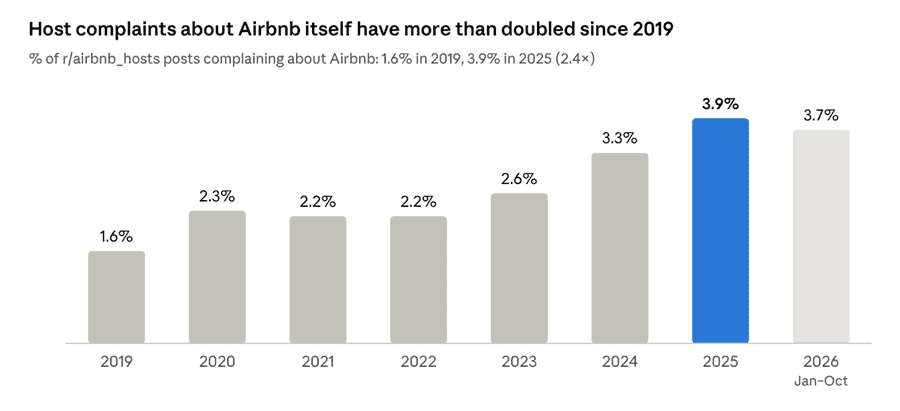
r/airbnbhosts posts via Arctic Shift · 46,000 posts, Jan 2019 to Oct 2026 · 2026 is January–October
The complaints track Airbnb’s changes closely, often within weeks:
- March–April 2020: about a quarter of all posts mentioned cancellations after the COVID refund override.
- July–October 2026: fee mentions reached about 14% of posts in July and October, the highest months on record, after the UK moved to the host-only fee in June.
- October 2026: house rules featured in 8% of posts, a record, when the new limits were announced. Talk of leaving Airbnb or going direct reached its highest three-month average.
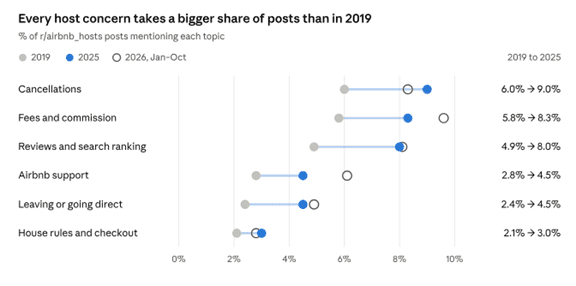
ref:- r/Airbnb hosts posts via Arctic Shift · keyword topic matches, Jan 2019 to Oct 2026
Surveys say the same. Increasing direct bookings is the top priority for 69.1% of self-managing hosts in 2026 (Hospitable, via The Host Report). A direct booking website is the investment hosts most want to make next, for the second year running (PriceLabs).
But behaviour points the other way. Key Data’s Q2 2026 figures show Airbnb reaching 50% of US short-term rental reservations, while direct bookings fell to 23% of reservations from 26% a year earlier (The Host Report). Hosts are more unhappy with Airbnb and more dependent on it at the same time. That gap is Airbnb’s leverage, and the reason it can keep changing the deal.
The interactive version, with monthly data and every policy date marked, is in the host dissatisfaction dashboard.
What it means for 2027
Airbnb is building a standardised, hotel-like product, and in 2027 hosts will be judged on how well they fit it. The platform still brings in demand that most operators can’t replace, so the job is to run Airbnb as a channel on your own terms rather than as the whole business.
- Price for the single fee, every channel. Treat 15.5% as a line in the P&L, and set rates per channel so the net payout matches. The comparison with Booking.com and direct is now explicit.
- Use the cancellation controls that remain. Seasonal policies (Firm on peak dates) and a non-refundable rate are the levers left. Every booking is provisional for 24 hours, so build that into how you forecast.
- Rewrite house rules before 20 November. Move checkout chores into the cleaning fee and the cleaner’s scope. Keep rules to the seven standard settings plus genuinely reasonable requests, and document any legal or HOA basis for asking for ID.
- Build the direct channel around repeat guests, within the rules. Airbnb bans steering a first booking off-platform. Repeat stays, referrals and search traffic are the realistic direct pipeline.
- Expect more casual supply and more hotels. Airbnb is recruiting part-time hosts around big events and adding boutique hotels. Professional operators will compete on consistency and reviews, which Airbnb’s ranking rewards.
- Watch host sentiment as a leading indicator. Spikes in complaints about fees or rules came within weeks of each change. They are a cheap early signal of where hosts, and supply, will move next.
Airbnb’s bet is that guests value predictability more than hosts value control, and so far the booking data supports it. The open question for 2027 is how far it can push before supply starts to leave.
Airbnb’s bet is that guests value predictability more than hosts value control, and so far the booking data supports it.
Shares: investors are backing the guest-first strategy
Investors have not punished Airbnb for the changes hosts dislike. Shares closed 2025 at $135.72 and stood at $168.36 in November 2026, up about 24% this year. In August they reached $183.22, the highest month-end since March 2021. They remain below the record close of $216.84 on 11 February 2021 (Macrotrends), and well above the $68 IPO price of December 2020.
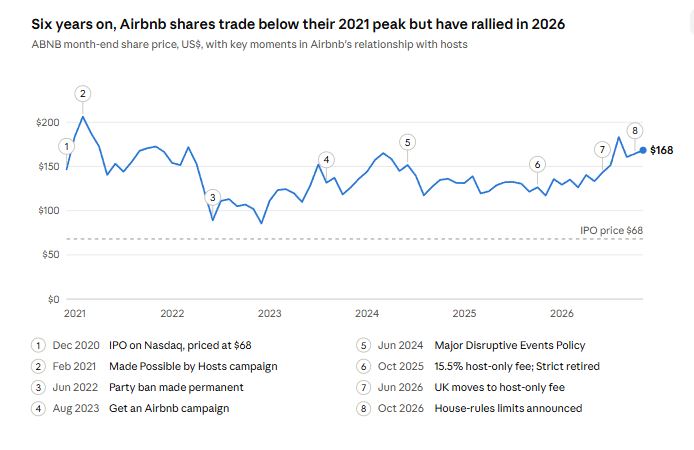
The markers show timing, not cause. A monthly chart can’t separate the effect of a single host policy from earnings and the wider market. What it does show is that Airbnb has made its biggest changes to the host deal while its share price recovered, so it has little market pressure to reverse them.
The open question for 2027 is how far it can push before supply starts to leave.
Method and sources
Host sentiment data. Every post (title and body, not comments) on r/airbnbhosts from January 2019 to October 2026, about 46,000 in total, from the Arctic Shift Reddit archive.
• Complaints about Airbnb: posts that name Airbnb, AirCover or support close to a grievance word, or say the host is leaving or done with Airbnb. A hand check of a random sample found about half of the flagged posts were genuine complaints about Airbnb, so the trend is more reliable than the level. A broader rule shows the same rise.
• Topics: keyword matches, so they count mentions, not complaints.
• Bias: people who post are not all hosts, and unhappy and professional hosts are over-represented.
Sources
• Fees: Airbnb 10-K FY2025 · Hostex · Truvi · Guesty · BNBCalc · Hospitality ON
• Cancellations: Airbnb, cancellation policies (2020) · Airbnb 10-K FY2022 · Airbnb, Major Disruptive Events Policy · Skift · Hostfully · PriceLabs · Nowistay · iGMS
• House rules: ABC News · Zeevou · Rental Scale-Up · Live 5 News · SAN · CNBC · TechCrunch
• Marketing: The Brand Hopper · LBB · Motley Fool · Short Term Rentalz · PYMNTS · Skift, Get an Airbnb · Skift, Services ad · Rental Scale-Up, 2026 ads
• Host behaviour: Key Data via The Host Report · PriceLabs Global Host Report 2026 · The Host Report
Trust research
• Bies, R. J., & Moag, J. S. (1986). Interactional justice: Communication criteria of fairness. Research on Negotiation in Organizations, 1, 43–55.
• Colquitt, J. A. (2001). On the dimensionality of organizational justice: A construct validation of a measure. Journal of Applied Psychology, 86(3), 386–400.
• Kumar, N., Scheer, L. K., & Steenkamp, J.-B. E. M. (1995). The effects of perceived interdependence on dealer attitudes. Journal of Marketing Research, 32(3), 348–356. Abstract
• Lewicki, R. J., McAllister, D. J., & Bies, R. J. (1998). Trust and distrust: New relationships and realities. Academy of Management Review, 23(3), 438–458.
• Mayer, R. C., Davis, J. H., & Schoorman, F. D. (1995). An integrative model of organizational trust. Academy of Management Review, 20(3), 709–734.
• Morrison, E. W., & Robinson, S. L. (1997). When employees feel betrayed: A model of how psychological contract violation develops. Academy of Management Review, 22(1), 226–256.
• Pavlou, P. A., & Gefen, D. (2005). Psychological contract violation in online marketplaces: Antecedents, consequences, and moderating role. Information Systems Research, 16(4), 372–399.
• Robinson, S. L., & Morrison, E. W. (2000). The development of psychological contract breach and violation: A longitudinal study. Journal of Organizational Behavior, 21(5), 525–546.
• Rousseau, D. M. (1995). Psychological Contracts in Organizations: Understanding Written and Unwritten Agreements. SAGE.Don’t Ignore Your Data!
